
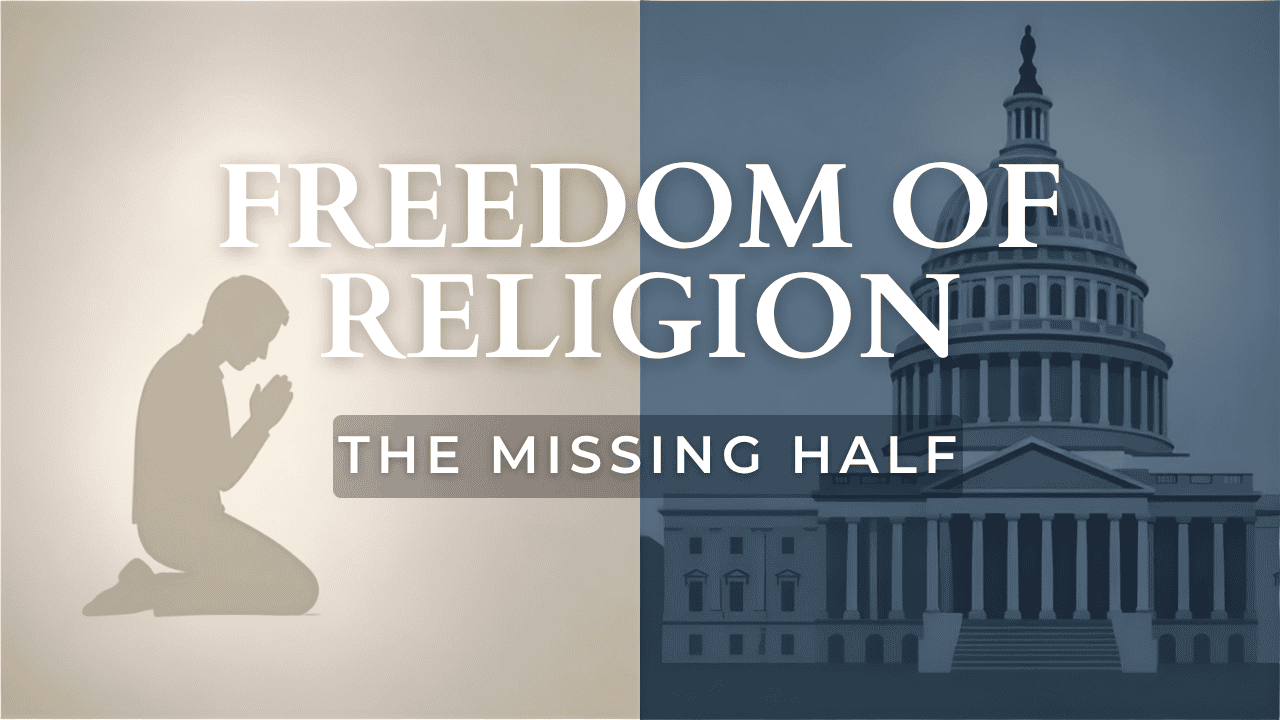
Why the First Amendment Has Two Rules About Religion — and Most People Only Quote One
You’ve heard it before: “America is a Christian nation. The Constitution says we have freedom of religion.”
The first sentence is debatable. The second sentence is true — but it is only half the story.
The First Amendment contains two separate rules about religion. Most Americans can name one, but almost nobody talks about the other. That missing half changes the entire meaning of the phrase “freedom of religion.”
This is not a debate about whether Christianity is good or bad, or about whether the Founders were religious. It is about reading the actual text of the Constitution and letting it speak for itself.
What the First Amendment Actually Says
Here is the full text of the religion portion:
“Congress shall make no law respecting an establishment of religion, or prohibiting the free exercise thereof.”
One sentence. Two commands. Two completely different protections.
Establishment Clause
Limits government’s ability to establish, impose, or coerce religious observance.
Free Exercise Clause
Protects people against government prohibition or discrimination in the exercise of religion.
| Clause | The Words | What It Means |
|---|---|---|
| Establishment Clause | “Congress shall make no law respecting an establishment of religion” | Government cannot create an official religion or exercise governmental power in ways prohibited by the Establishment Clause. |
| Free Exercise Clause | “or prohibiting the free exercise thereof” | Government generally cannot prohibit or discriminate against the exercise of religion. |
Most people who cite “freedom of religion” are thinking of the Free Exercise Clause — the right to believe and practice what you want. This protects Christians, Muslims, Jews, Hindus, Buddhists, atheists, and everyone else.
The Establishment Clause comes first in the text. However, neither protection has constitutional priority over the other, and both appear in the same sentence.
The First Amendment protects your right to practice religion (Free Exercise) and limits the government’s ability to impose, establish, or coerce religious observance (Establishment). Both clauses matter. Quoting only one is reading half the sentence.
The Bigger Picture: Why Did the Framers Write It This Way?
In the 18th century, most countries had official state churches, and several American colonies had established churches before independence. If you belonged to the wrong faith, you could be taxed to support a church you didn’t attend or barred from holding office.
James Madison, who wrote the First Amendment, fought to end this. He argued that government involvement in religion corrupted both the government and the religion itself. When Madison drafted the First Amendment in 1789, the Establishment Clause was not anti-religion; it was anti-government-controlled-religion.
The “Christian Nation” Argument
Here is the claim you hear most often: “America was founded as a Christian nation. The Founders were Christians.”
Some Founders were traditional Christians, while others, like Thomas Jefferson and James Madison, held more unorthodox views. Calling the Founders collectively “Christian” oversimplifies a very diverse group of thinkers.
More importantly, the Constitution itself says almost nothing about religion:
| Constitutional Text | What It Says | What It Means |
|---|---|---|
| First Amendment | “No law respecting an establishment of religion” | No national church, including Christianity. |
| Article VI | “No religious Test shall ever be required as a Qualification to any Office…” | You cannot be required to be a specific religion to serve in government. |
| Main Body | No mention of God, Jesus, Christianity, or the Bible. | A deliberate omission in a document written by people who knew how to invoke God when they wanted to. |
The Treaty of Tripoli
In 1797, the U.S. Senate unanimously ratified the Treaty of Tripoli, which contained this language: “As the Government of the United States of America is not, in any sense, founded on the Christian religion…” It negotiated during George Washington’s administration and signed by President John Adams.
The Treaty of Tripoli, signed in 1796 and ratified in 1797, was an agreement between the United States and the North African state of Tripoli (now Libya). Its primary goal was to protect American merchant shipping from Barbary pirates.
The Constitutional Reality vs. Cultural History
Christian Influence Is Real
Christianity has deeply influenced American holidays, art, political movements, charitable institutions, and social history.
No Established Christian Nation
The Constitution prohibits religious tests for federal office, while the First Amendment limits government establishment of religion and protects free exercise.
America’s culture is undeniably shaped by Christianity. Our holidays, art, and social movements—like abolitionism and civil rights—have deep religious roots.
However, cultural history and constitutional design are different things. America having a Christian-influenced culture is not the same as America being constitutionally a Christian nation. The Constitution was designed to prohibit religious tests for federal office, and the First Amendment prevented Congress from establishing religion or interfering with its free exercise.
If the government could establish Christianity, which version? Catholic? Baptist? Methodist? Historically, different denominations persecuted each other for centuries. The Framers wanted the new federal government out of that fight.
Real-World Impact: What This Looks Like Today
| Issue | Free Exercise Argument | Establishment Argument | Current Status |
|---|---|---|---|
| Public School Prayer | Students should be free to pray. | Schools shouldn’t lead or organize prayer. | Students can pray privately; school-led prayer has been struck down. |
| Ten Commandments on Public Property | Reflects legal or cultural heritage. | Government displaying or promoting a specific religious text. | Depends on context, history, and the nature of the display. |
| Government Funding for Religious Schools | Parents should be able to choose faith-based education. | Tax money shouldn’t fund religious instruction. | Shifting — recent cases allow some aid. |
| Coach Praying on Field After Games | Coach should be free to pray publicly. | Students may feel pressured to join. | Court allowed it in Kennedy v. Bremerton (2022). |
The Court Is Shifting Modern Supreme Court doctrine on religious liberty has changed significantly. The Court has moved toward an approach grounded in historical practices.
Recent rulings have:
- Allowed public funds to go to religious schools.
- Permitted a coach to pray on the football field.
This shift means the balance between the two clauses is changing. Expanding Free Exercise gives religious individuals more room to operate in public, while narrowing the Establishment Clause allows the government to do more with religion than it could before.
People Are Asking
Does the First Amendment only protect Christians?
No. The text says “religion,” not “Christianity.” First Amendment protections extend across religious traditions and also protect people who hold no religious belief.
Does freedom of religion mean freedom from religion?
The First Amendment protects your right to practice religion, but it also limits the government’s ability to impose or coerce religious observance. Religious Americans have the same rights to speak, vote, pray, and participate in public life as everyone else.
If most Americans are Christian, why can’t the government reflect that?
The Constitution was built to prevent majority preference from becoming government policy on religion. It protects both the majority’s right to believe and the minority’s right to be left alone.
What You Can Do
- Read the actual text. The First Amendment is one sentence. Read both halves.
- Distinguish between culture and Constitution. A Christian-influenced culture is a fact; a constitutionally established Christian nation is not.
- Watch for selective quotation. When someone invokes “freedom of religion,” pay attention to which constitutional protection they’re talking about. The Free Exercise Clause protects religious practice, while the Establishment Clause limits government’s role in religion. Understanding religious liberty requires considering both.
- Respect sincere belief. You can respect someone’s faith while still demanding constitutional accuracy.
Related VoteView Articles:
- US Constitution Explained
- The Supreme Court Series: When the Supreme Court Got It Wrong
- Checks and Balances Series: What Are Checks and Balances?
- The Manufacturing of Culture Wars (upcoming)
If you are looking for historical evidence beyond what is in this article check out these key primary sources:
The Federalist Papers: Written by Alexander Hamilton, James Madison, and John Jay to explain and defend the new Constitution to the public, these essays focus entirely on political theory, checks and balances, and civic structure, completely avoiding arguments based on divine authority.
The Records of the Federal Convention of 1787: The transcripts and notes from the Constitutional Convention show that the delegates debated the structure of the government for months, yet there was no serious push to include an acknowledgment of God or establish a national religion. Instead, they overwhelmingly agreed to include Article VI, which explicitly bans religious tests for holding public office.
James Madison’s “Memorial and Remonstrance Against Religious Assessments” (1785): Written shortly before the Constitution, this is Madison’s most famous essay arguing against state-sponsored religion. It proves his intent to keep government power entirely separate from religious institutions.


No discussions yet
Be the first to join the discussion and share your thoughts with the community.