
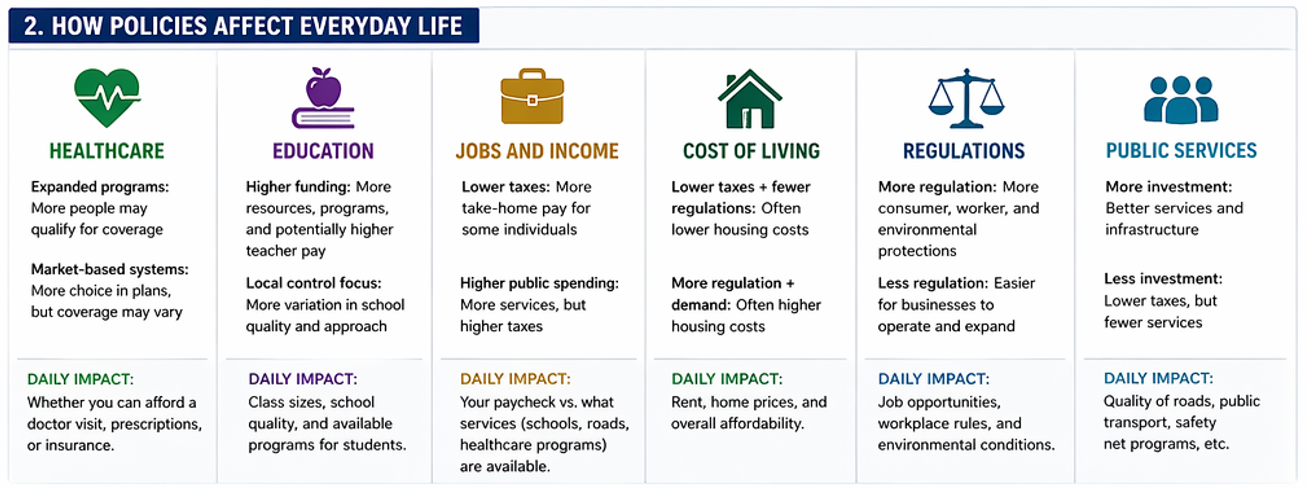
Public policy can often feel like an abstract debate happening far away in a state capitol or Washington D.C. In reality, the laws passed by legislators shape the most intimate details of your daily survival.
From the price of your life-saving medication to the quality of your child’s third-grade classroom, policy dictates your options. Let’s break down how different government approaches create completely different everyday realities for American families.
🏥 Healthcare Policy: Affordability vs. Underlying Costs
American healthcare debates usually focus heavily on insurance access. However, the true crisis for families often boils down to the staggering, unregulated baseline cost of medical care.
This model aims to expand public programs like Medicaid or subsidize private insurance. It helps more lower-income families get covered, but it often requires massive public funding through taxes.
This model favors less government regulation and promotes private competition. It gives consumers more plan options, but it leaves vulnerable families exposed to gaps in coverage.
👉 Daily Impact: Policy dictates whether a sudden medical emergency results in a standard copay or complete, multi-generational financial ruin.
🎓 Education and Regional Economic Growth
Public education highlights the deep fiscal relationship between local tax policies and community opportunities.
States that collect higher taxes often pour massive resources into public education. This results in competitive teacher salaries, robust special programs, and smaller class sizes.
States that minimize tax rates give families more immediate take-home pay. However, this often starves local school districts of vital infrastructure, resources, and competitive talent.
👉 Daily Impact: Your local zip code determines your child’s access to modern textbooks, safe school buildings, and competitive career counseling.
🏡 Cost of Living and Corporate Regulation
Government regulation acts as a see-saw between consumer protection and corporate operational costs.
High regulation guarantees strong protections for workers, rigorous environmental standards, and robust consumer safety nets. However, compliance costs can drive up local rent, utilities, and goods.
Low regulation makes it fast and cheap for businesses to operate, build housing, and expand. While this lowers immediate consumer costs, it can leave workers and the environment with fewer vital safeguards.
👉 Daily Impact: Regulation directly impacts the size of your monthly utility bills, your workplace safety, and the cleanliness of your local drinking water.
💡 Why Voters Polarize Over Policy Solutions
Most political disagreements are not about the end goals. They are about the mechanisms used to achieve them:
- Left View: Treat healthcare as a public utility to control costs and guarantee access.
- Right View: Deregulate markets to spark competition and lower costs naturally.
- Left View: Boost state funding and enforce uniform national standards.
- Right View: Protect local control and empower parents through choice programs.
- Left View: Tax top earners to build robust social infrastructure and public safety nets.
- Right View: Cut corporate taxes to incentivize investment and job creation.
🧠 The Philosophical Divide
- One side believes collective government investment is required to ensure basic human dignity and economic stability.
- The other side believes individual freedom and decentralized markets yield the most efficient, innovative solutions.
Both frameworks attempt to address real structural issues. They simply follow opposite maps.
⚖️ The Unavoidable Policy Trade-Offs
Every single policy vote involves a mathematical and social compromise:
- Lower individual taxes always lead to fewer shared public services.
- Expanded public safety nets always require a higher collective tax burden.
- Increased corporate regulation protects consumers but raises consumer prices.
- Sweeping deregulation lowers prices but increases systemic risk.


No discussions yet
Be the first to join the discussion and share your thoughts with the community.