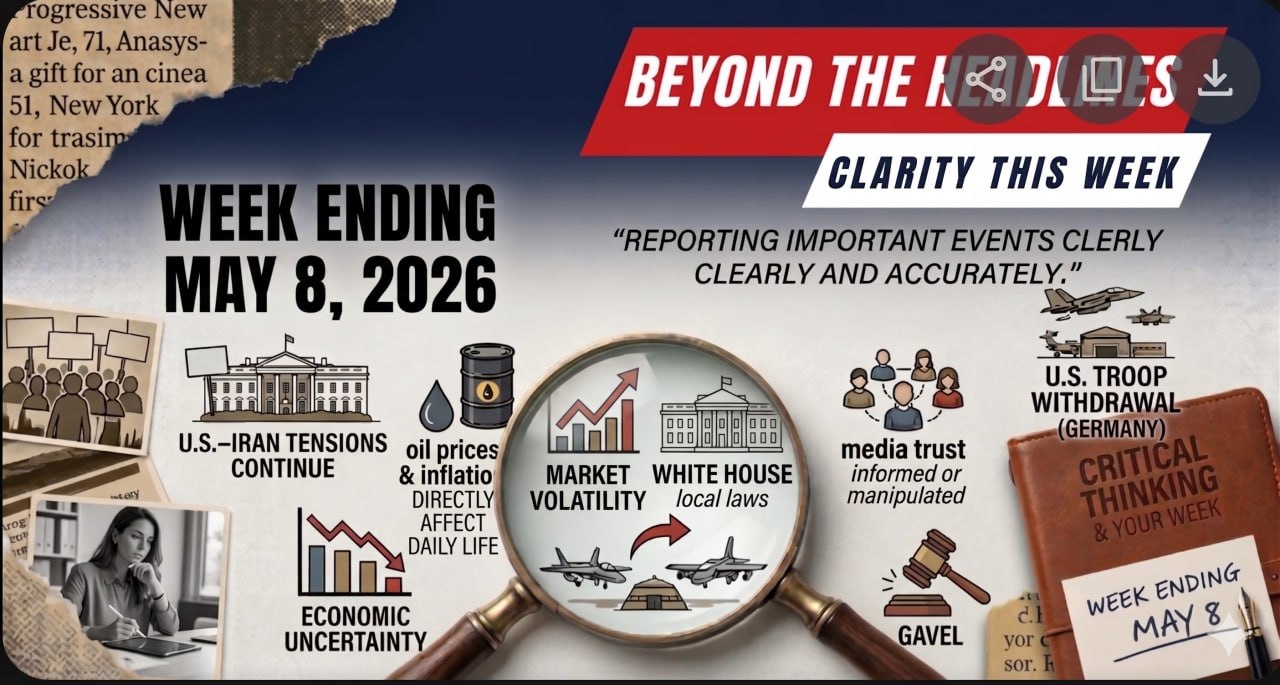
The news this week isn’t just about distant conflicts or courtrooms. It’s about the price you pay at the pump, the value of your vote, and who you trust to tell you the truth.
- Oil prices and inflation directly affect your grocery bill and monthly budget.
- Voting rights rulings change the political map of your neighborhood.
- Media trust debates influence whether you feel informed or manipulated.
Real life example: One person reads that the economy is “booming” because stock markets are up. Another reads that the economy is “crashing” because gas prices are rising. Both are looking at the same week of news, but seeing different realities.
Geopolitics (Iran/Troops)
When shipping lanes close or troops move, supply chains break. This means higher costs for goods and energy.
Policy (Supreme Court)
When voting maps change, the balance of power shifts. This affects local laws, school funding, and representation.
Perception (WHCD/Media)
When institutions seem disconnected, trust erodes. This makes it harder to agree on solutions to common problems.
Simple way to think about it: You’re not just watching history happen—you’re living inside the consequences.
- Some focus on the big picture: “Global stability is worth the cost.”
- Others focus on the local pain: “My rent is too high right now.”
- People value different things: Some want security (trust institutions), others want accountability (distrust institutions).
- Financial Anxiety: Uncertainty about rates and oil makes it hard to plan mortgages or savings.
- Civic Confusion: Conflicting reports make it unclear how to prepare for the next election.
- Social Friction: Arguments become more intense when everyone believes they have the “true” story.
A divided information environment makes it harder to solve economic problems together. Trust deficits can lead to disengagement, and polarization increases when people feel the system is rigged against them.
Big risk: If we can’t agree on what is happening, we can’t agree on how to fix it.
The events of this week are already shaping your financial security, your civic power, and your mental clarity. Understanding the mechanics is the first step to protecting yourself.
- Check the source: Is this reporting facts or interpreting feelings?
- Look for the cost: Ask “Who pays for this?” for every policy.
- Be aware of emotions: Strong anger often means you’re being targeted by a narrative.
👉 Read the Details: View Top Current News Stories — Week Ending May 8
No discussions yet
Be the first to join the discussion and share your thoughts with the community.